
Global Economy | Bureau Analysis | February 2026
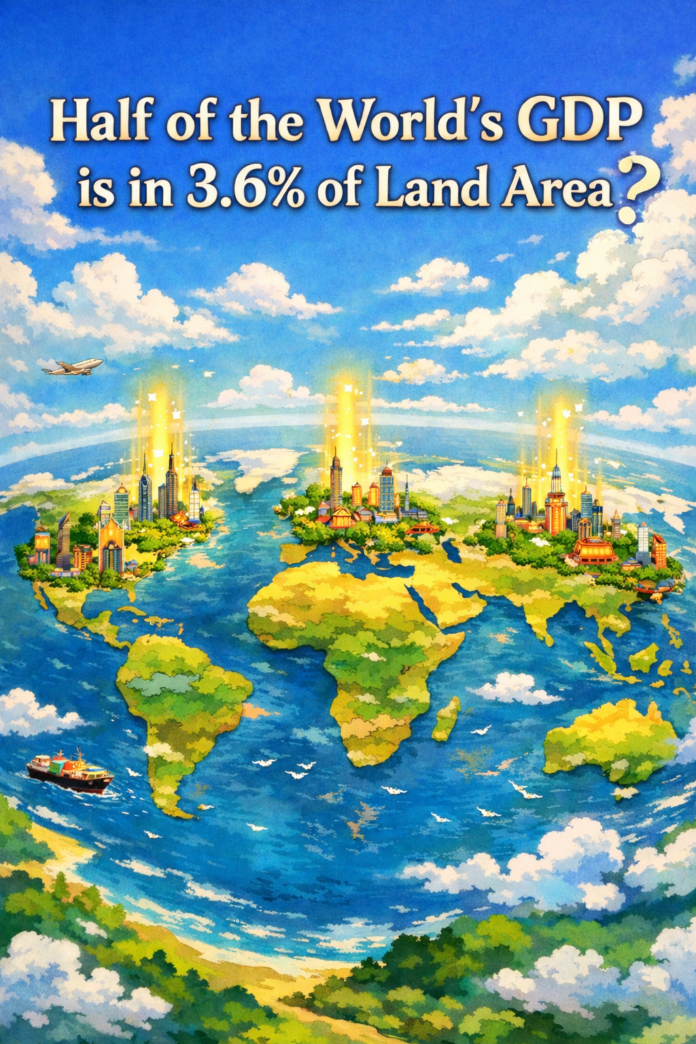
A striking claim has been circulating in economic commentary and social media: “Half of the world’s GDP is concentrated in just 3.6% of global land area.”
The statistic, paired with maps highlighting small regions in North America, Western Europe, and East Asia, suggests that economic geography is far from evenly distributed.
But is the number accurate? And if broadly directionally correct, what does it really mean?
The Short Answer: The Pattern Is Real — The Exact Number Depends on Methodology
There is strong academic evidence that global economic output is heavily concentrated in a small number of urban corridors and megaregions. However, the precise figure of “3.6%” depends on how land area and GDP are measured.
Economists studying economic agglomeration consistently find that:
- A minority of metropolitan regions generate a disproportionately large share of global GDP.
- Urban clusters, not entire countries, are the real engines of value creation.
- High-density economic corridors drive global trade, finance, technology, and capital markets.
Whether the figure is 3%, 5%, or slightly higher, the underlying structural reality remains: global economic output is geographically concentrated.
The Three Major “Megaregions” Driving Value Density
Most global economic output is clustered in three dominant corridors.
1. The United States Innovation Belt
The US Northeast Corridor (Boston–New York–Washington) combined with Silicon Valley and parts of Texas and California represents one of the most productive economic clusters globally.
These regions host:
- Major financial markets
- Technology giants
- Venture capital ecosystems
- Advanced research universities
The GDP generated within these dense metros rivals or exceeds that of many entire continents.
2. Europe’s Industrial Spine (“Blue Banana”)
Stretching from London through the Benelux countries, Western Germany, Switzerland, and Northern Italy, this corridor remains one of the most industrially and financially integrated regions in the world.
It includes:
- Europe’s largest financial hubs
- Advanced manufacturing clusters
- Automotive and precision engineering centers
- Dense transport infrastructure
This zone alone accounts for a significant portion of European Union GDP.
3. East Asia’s “Golden Arc”
The Tokyo–Seoul–Taipei–Shenzhen axis represents one of the world’s highest value-per-square-mile economic concentrations.
This region includes:
- Semiconductor manufacturing hubs
- Consumer electronics supply chains
- High-end chip fabrication
- Deep capital markets integration
Taiwan, in particular, plays a critical role in global semiconductor production — a concentration sometimes described by analysts as creating a form of economic “interdependence shield,” because disruption would impact global supply chains.
Why Is Economic Activity So Concentrated?
The phenomenon is explained by agglomeration economics, a well-documented theory in urban and regional economics.
Talent Clustering
High-skilled workers tend to migrate toward cities where other skilled professionals are located. This creates innovation ecosystems that are difficult to replicate.
Capital Proximity
Venture capital firms, institutional investors, and multinational corporations prefer dense hubs because:
- Exit opportunities are nearby
- M&A ecosystems are mature
- Legal and financial services are integrated
Infrastructure Efficiency
Building advanced infrastructure — from high-speed rail to 5G/6G networks — is significantly more cost-efficient in densely populated corridors than across sparsely populated regions.
This creates a reinforcing loop: density attracts capital; capital attracts more talent; talent increases productivity.
Is Economic Geography “Undemocratic”?
The phrase may sound provocative, but economically speaking, geography has never been evenly distributed.
Natural ports, rivers, climate stability, energy access, and trade routes historically shaped prosperity. In the digital era, proximity to innovation networks and advanced infrastructure has replaced rivers and ports as drivers of value.
Importantly, concentration does not mean exclusion. Digital services, cloud computing, and cross-border trade increasingly allow participation from outside these corridors — though the highest-value nodes remain clustered.
The Geopolitical Dimension
Economic density has strategic implications.
Regions producing high-value goods — such as semiconductors, aerospace components, or advanced pharmaceuticals — often become strategically significant. Governments may prioritize resilience and diversification to reduce systemic risk.
However, interpretations such as “economic shields” or inevitable geopolitical outcomes remain analytical perspectives rather than policy certainties.
The Emerging Question: Can New Nodes Be Created?
Infrastructure projects, sovereign wealth fund investments, and emerging technology clusters are often attempts to build “new density zones.”
Whether in advanced manufacturing hubs, AI research corridors, or renewable energy megaprojects, the goal is consistent: create the next high-value economic node before it becomes prohibitively expensive to enter.
Even speculative future concepts — such as space-based energy systems — reflect the broader economic principle of concentrating value production into efficient nodes.
Conclusion
While the exact “3.6%” figure may vary depending on methodology, the broader structural reality is clear:
Global GDP is highly concentrated in a small number of dense metropolitan and industrial corridors.
Economic geography is shaped by agglomeration effects, infrastructure efficiency, capital networks, and talent mobility — not by equal land distribution.
As the global economy evolves, the key question is not whether concentration exists, but where the next high-density growth corridors will emerge.
Editorial & Compliance Note
This article is based on publicly available economic research and analytical interpretations. Figures referenced are illustrative and may vary by dataset or methodology. The content is for informational and analytical purposes only and does not constitute investment, geopolitical, or strategic advice. Readers are encouraged to consult official economic data sources for precise statistical verification.ReportingNewsWorld maintains editorial neutrality and does not provide economic advisory services.