
Bureau Report | Global Trade & Corporate Finance | Washington D.C., USA
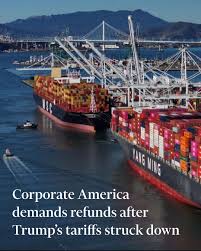
WASHINGTON D.C. — A massive legal and fiscal storm is brewing in the United States as “Corporate America” begins mobilizing to claw back more than $130 billion in import levies. The move follows a landmark U.S. Supreme Court (SCOTUS) decision that struck down the administration’s authority to impose broad reciprocal tariffs under the International Emergency Economic Powers Act (IEEPA).
Battle lines are now forming between major retail giants, automotive manufacturers, and tech firms over who will be first in line to recover the billions paid into the U.S. Treasury over the last year.
The $130 Billion Question: Who Gets Paid?
The ruling has created an unprecedented administrative challenge for the U.S. Customs and Border Protection (CBP). While the court ruled the collection was “unauthorized,” the path to repayment is fraught with legal complexity.
- The Claimants: Industry leaders in the Consumer Electronics and Automotive sectors—who bore the brunt of the 2025 tariff hikes—are expected to file the largest claims.
- The Treasury’s Dilemma: Refunding $130 billion could significantly widen the U.S. federal deficit, potentially triggering a downgrade in credit outlooks or forcing the administration to seek emergency offsets from Congress.
- Legal Precedent: Corporate lawyers argue that the levies were “void ab initio” (void from the beginning), meaning every cent must be returned with interest. However, government attorneys may argue for a “prospective-only” application of the ruling to avoid a fiscal meltdown.
Market Impact: A Stimulus or a Crisis?
Economists are divided on the impact of a potential $130 billion liquidity injection into the private sector.
- Bullish Perspective: Proponents argue that these refunds will act as a massive “de-facto stimulus,” allowing companies to reinvest in R&D, lower prices for consumers, and settle debts.
- Bearish Perspective: Critics fear the sudden outflow from the Treasury will destabilize the U.S. Dollar and put upward pressure on Treasury yields, complicating the Fed’s efforts to manage the economy.
Global Repercussions: The “Bharat” Perspective
As reported by the FITIG Association, the global trade community is watching closely. If U.S. companies receive massive refunds, it may shift the competitive landscape for Bharatiya (Indian) exporters. While the SCOTUS ruling creates chaos in the U.S., Bharatiya (Indian) firms are currently operating under a stable 18% reciprocal deal that remains legally distinct from the broader global tariffs that were struck down.
However, the “trade vacuum” created by the SCOTUS decision is one reason why gold prices have spiked to $5,100+, as investors hedge against a potential U.S. fiscal crisis.
Editorial & Compliance Note
This article reflects market commentary and publicly discussed information. It is intended for informational purposes only and does not constitute investment advice, financial recommendation. ReportingNewsWorld maintains editorial neutrality and does not provide economic advisory services.