Bureau Report | BUSINESS , PHARMA , GLOBAL TRADE | BENGALURU, KARNATAKA, BHARAT (INDIA)
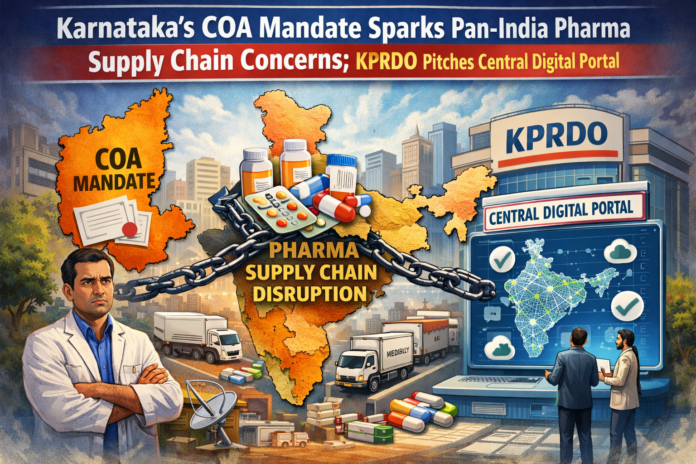
“If COA is implemented only in Karnataka, how can medicines be purchased from companies in other states?” – KPRDO Flags Disruption Risk in Pharma Supply Chain
“Interstate and online transactions—some of which function outside the conventional wholesale channel—raise the question of how uniform compliance will be ensured across all trading entities.” – KPRDO to FDA Commissioner
The Business Challenge: COA Compliance in Numbers
The pharmaceutical wholesale business in Karnataka, as elsewhere in India, operates on thin margins and high volumes. KPRDO’s representation highlights a fundamental business challenge: wholesalers handle thousands of purchase transactions involving multiple batches on a continuous basis. Collecting, verifying, and maintaining batch-wise COAs for every transaction represents an enormous operational burden [citation:0].
The scale of this requirement can best be understood by those directly engaged in wholesale trade. A typical wholesaler may deal with hundreds of manufacturers and thousands of products, each with multiple batches annually. The administrative cost of managing physical COA documents – storage, cataloging, retrieval, and production upon demand – would consume resources that small and medium wholesalers can ill afford [citation:0].
The Interstate Trade Dilemma
The most significant business concern raised by KPRDO pertains to interstate trade. Karnataka manufactures only a fraction of the total drugs required in the state, with a substantial portion procured from manufacturers located in other states [citation:0].
If COA is implemented only in Karnataka, pharmaceutical manufacturing companies in other states may not even be aware of such a requirement. In such a situation, wholesale drug distributors in Karnataka may not be able to procure medicines on time. This could lead to shortages of medicines and may adversely affect the public healthcare system [citation:0].
KPRDO has posed a pointed question to the FDA: “If COA is not implemented in other states, the pharmaceutical manufacturing companies in those states may not even be aware of such a requirement. In such a situation, wholesale drug distributors in Karnataka may not be able to procure medicines on time” [citation:0].
The organization further questions how compliance will be ensured across all trading entities, particularly when interstate and online transactions function outside the conventional wholesale channel. It is, in their words, “unfortunate that traditional brick-and-mortar wholesalers of Karnataka appear to be disproportionately impacted in matters of regulatory compliance” [citation:0].
The Digital Solution: A GST-Style Portal
KPRDO has proposed that the matter be referred to the Central Government for the creation of a centralized digital portal, similar in structure to the GST system. Under such a framework, manufacturers could upload batch-wise COA details directly onto the portal, enabling authorized access to wholesalers and regulatory authorities as required [citation:0].
This proposal would address multiple business challenges:
- Eliminate Physical Documentation: Moving to a digital repository would eliminate the need for voluminous physical storage, which presents logistical difficulties when trade margins are under severe pressure [citation:0].
- Ensure Uniform Compliance: A pan-India portal would ensure that all manufacturers across states comply with the same requirements, eliminating interstate disparities [citation:0].
- Reduce Administrative Burden: The process of systematically collecting, cataloguing, storing, and producing documents upon demand would be centralized, reducing the resource-intensive nature of compliance [citation:0].
- Support Environmental Goals: Mandating physical COA documents appears counterproductive at a time when both government and industry are striving toward paperless and environmentally sustainable operations [citation:0].
Existing Digital Infrastructure: SUGAM and Beyond
The good news is that such infrastructure already exists. The Central Drugs Standard Control Organization (CDSCO), in collaboration with C-DAC, launched the SUGAM portal in 2014 to automate regulatory processes. By October 2024, SUGAM had registered over 31,000 users, processed more than 419,000 applications, and issued 356,000 approvals .
In March 2025, CDSCO and C-DAC entered into new Memorandums of Understanding for the maintenance and enhancement of the SUGAM Portal and the development of the Online National Drug Licensing System (ONDLS) for State Pharmaceutical Regulatory Processes . This initiative aims to establish connectivity between all 34 CDSCO centers across the nation, pharmaceutical industries, and state authorities, ensuring a transparent and efficient regulatory environment .
The National Single Window System (NSWS) Portal, established on January 1, 2024, by CDSCO, further demonstrates the government’s commitment to digital governance in the pharmaceutical sector .
Global Perspectives on COA Compliance
The COA requirement is not unique to India. In international pharmaceutical trade, COA is mandatory for customs clearance and regulatory compliance. Documents like COA, COO, and GMP certificates form the backbone of legal, quality-oriented global trade .
In the European Union, proposed guidelines for API distributors require them to transmit all regulatory and quality documents provided by the manufacturer to customers, including copies of original Certificates of Analysis and batch numbers. Distributors would also be required to maintain accurate records of API suppliers, meaning they would need to maintain databases .
In the United States, regulatory scrutiny of COA reliance is increasing. FDA inspections have cited companies for failing to justify the appropriateness of supplier testing and relying solely on COAs without independent verification .
However, a key difference is that in international trade, the volume of transactions is significantly lower, and the stakes (customs clearance, cross-border compliance) justify the documentation burden. For domestic wholesale trade involving thousands of transactions daily, the economics are fundamentally different.
The Cumulative Compliance Burden
KPRDO has also highlighted a broader business concern: the cumulative burden of multiple regulatory compliances. Traders are already managing obligations from various departments, including GST, Income Tax, Labour authorities, and local bodies [citation:0].
The organization notes that “the cumulative burden of these compliances consumes substantial time and resources, particularly for small and medium-scale wholesalers operating on minimal margins. The present requirement, if enforced in its current form, may severely disrupt their operations and viability” [citation:0].
This raises a fundamental question for policymakers: How much compliance can a small business absorb before it becomes unsustainable? The answer must balance regulatory objectives with business realities.
The Spurious Drugs Challenge
None of this is to minimize the challenge of spurious drugs. The market for counterfeit medicines in India is estimated to be worth $3 billion, compared to $50 billion for the total pharma market as of FY24 . In December 2024, authorities seized spurious anti-cancer and anti-diabetic drugs worth ₹6.60 crore in Kolkata .
The Central Drugs Standard Control Organization (CDSCO) is working on stringent rules to hold retailers and wholesalers accountable for selling or storing spurious drugs, even if they hold valid purchase invoices . A committee has been formed to explore ways to narrow down exemptions under Section 19 of the Drugs and Cosmetics Act, 1940, which currently protects retailers and wholesalers from prosecution if they can produce valid purchase invoices .
Rajiv Singhal, general secretary of the All India Organization of Chemists and Druggists, argues that retailers should not be held responsible for spurious drugs if they source medicines through authorized channels with valid invoices. He notes that chemists operate within a structured supply chain including C&F agents, wholesalers, and retailers. If medicine is found to be spurious, the liability should lie with those introducing counterfeit products into the market, not with retailers who have followed due process .
The Way Forward: A Phased Approach
Industry experts suggest a phased approach to COA implementation:
Phase 1: Digital Infrastructure Development
Leverage existing platforms like SUGAM to create a centralized COA repository where manufacturers upload batch-wise certificates. This would eliminate the need for physical document transfer and storage [citation:0].
Phase 2: Pilot Implementation
Test the system in one or two states before nationwide rollout, allowing for refinement based on stakeholder feedback.
Phase 3: Pan-India Rollout
Once the system is proven, implement it uniformly across all states, ensuring a level playing field for all trading entities.
Phase 4: Integration with Other Systems
Integrate the COA portal with GST and other regulatory systems to create a seamless compliance ecosystem.
Conclusion: Balancing Act
KPRDO’s representation highlights the delicate balance between regulatory objectives and business viability. While the goal of eliminating spurious drugs is laudable, the means adopted must be practical and proportionate.
The organization has requested that the compliance of COA be revoked in its current form, and the matter be referred to the Central Government for creating a pan-India digital framework [citation:0]. Given the existing digital infrastructure and recent initiatives by CDSCO, this approach offers a viable path forward.
As KPRDO aptly notes, “We trust that the Government recognizes its responsibility not only toward public health but also toward sustaining the legitimate trade community that forms an essential link in the pharmaceutical supply chain” [citation:0]. This recognition must translate into policies that are both effective in achieving public health goals and sensitive to the realities of business operations.
The coming months will reveal whether the Karnataka FDA heeds this call and whether the Central Government moves to create the digital infrastructure that could make COA compliance a reality without disrupting the vital pharmaceutical supply chain.
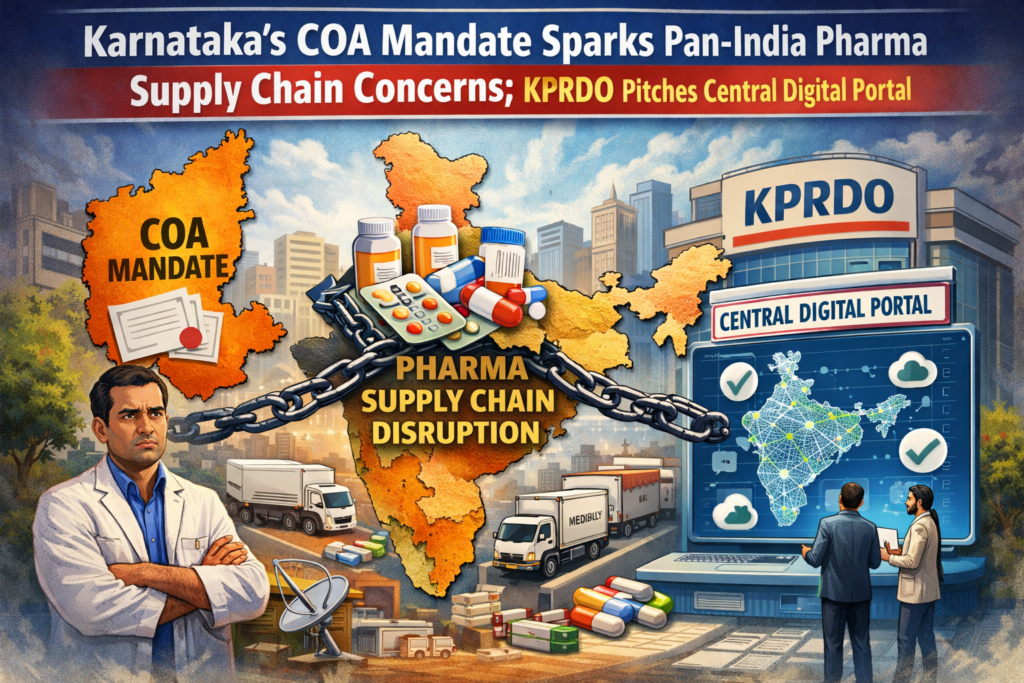
The Karnataka Pharma Retailers & Distributors Organization (KPRDO) has raised serious concerns over the FDA circular mandating Certificates of Analysis (COA) for all wholesale purchases. In a letter dated February 28, 2026, the organization has warned that unilateral implementation in Karnataka could disrupt interstate drug procurement, create supply shortages, and disproportionately impact traditional brick-and-mortar wholesalers. KPRDO has proposed a pan-India digital portal on the lines of GST to streamline compliance. This report examines the business implications, supply chain challenges, and the way forward.
Editorial & Compliance Note:
This article reflects market commentary and publicly discussed information. It is intended for informational purposes only and does not constitute investment advice, financial recommendation. reportingnewsworld.com maintains editorial neutrality and does not provide economic advisory services or political affiliations.