
Bureau Report | Trade & Markets
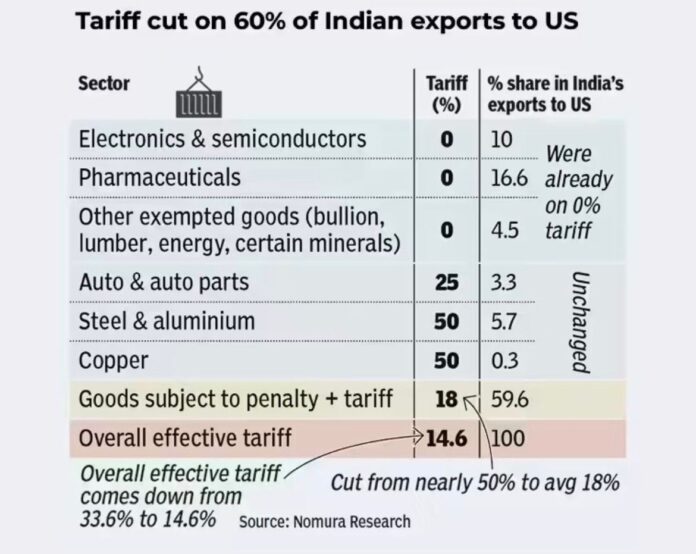
Recent tariff adjustments in the United States now reportedly cover approximately 60% of Indian exports to the US market, leading to a significant reduction in overall effective tariff exposure. According to trade and market commentary, the effective tariff burden on Indian exports has fallen from around 33.6% to approximately 14.6%.
While official trade notifications and sector-specific schedules govern the final implementation, analysts suggest that the revised structure reduces uncertainty for exporters and strengthens India’s position in selected high-value manufacturing segments.
Effective Tariff Burden Moderates
The reported reduction in the effective tariff rate from 33.6% to 14.6% is viewed as a material shift in trade competitiveness. A lower average tariff burden may:
-
Improve export pricing flexibility
-
Support margin stability for manufacturers
-
Enhance scale-led production economics
-
Reduce unpredictability in cross-border trade
Trade predictability is often a key factor influencing investment decisions in export-oriented industries.
High-Value Sectors Remain Tariff-Free
Several high-value sectors — including electronics, semiconductors, pharmaceuticals, and certain exempted commodities — reportedly continue to face 0% tariffs under the current structure.
These segments account for an estimated 26.6% share of exports referenced in market commentary. Zero-duty access in such categories can contribute to:
-
Earnings visibility
-
Stable export margins
-
Enhanced global supply chain integration
-
Incentivized capital expenditure in manufacturing
The pharmaceutical sector, in particular, benefits from long-standing trade frameworks and compliance alignment, while electronics and semiconductor-linked exports align with India’s broader production-linked incentive (PLI) ecosystem.
Sectoral Divergence: Autos, Metals, and Copper
While the average tariff burden has moderated, certain sectors — including automobiles, metals, and copper — reportedly face higher tariff rates relative to earlier levels.
However, these segments represent a smaller proportion of total Indian exports to the US market. Analysts note that sector-specific impact will vary based on product mix, cost structures, and contract dynamics.
Exporters in these industries may need to recalibrate pricing, explore market diversification, or enhance value-add manufacturing to maintain competitiveness.
Average Burden on Penalized Goods
Despite higher duties applying to an estimated 59.6% of goods under certain classifications, the weighted average tariff impact reportedly moderates to approximately 18%.
This suggests that while individual tariff lines may remain elevated, the overall trade exposure is cushioned by tariff-free high-value categories.
Implications for Export-Led Growth
India’s export ecosystem has increasingly focused on:
-
Manufacturing scale expansion
-
Value-chain integration
-
Compliance-driven production
-
Diversification beyond commodity-heavy exports
Lower effective tariffs in critical sectors can reinforce this export-led growth thesis, particularly for industries benefiting from:
-
Technology integration
-
Regulatory compliance alignment
-
Supply chain relocation trends
-
Production-linked incentive frameworks
Market participants suggest that selective opportunities may emerge in manufacturing, pharmaceuticals, electronics, and supply-chain beneficiary industries.
Caution: Trade Policy Remains Dynamic
Trade frameworks between major economies are subject to periodic review, negotiation, and regulatory updates. Tariff schedules may vary across product classifications and are often governed by bilateral or multilateral trade rules.
Exporters are advised to consult official US trade notifications, customs documentation, and government advisories before drawing operational conclusions.
Conclusion
The reported reduction in effective US tariffs on Indian exports — from 33.6% to 14.6% — marks a notable shift in trade conditions. While sector-specific divergence remains, the overall moderation in tariff exposure strengthens India’s competitiveness in several high-value categories.
For export-oriented industries, the development may enhance earnings predictability and margin resilience, subject to ongoing policy developments.
Compliance & Editorial Note
This article is based on market commentary and publicly discussed tariff metrics. It is published for informational and analytical purposes only and does not constitute investment advice or policy confirmation. Readers are encouraged to refer to official trade notifications, customs circulars, and government releases for authoritative details. ReportingNewsWorld maintains editorial neutrality and does not endorse specific securities or investment strategies.