
Bureau Report | Global Entertainment & Infrastructure | February 2026
In early February 2026, the Malta Film Commission officially announced plans for a major expansion of the Malta Film Studios in Kalkara through the development of an ambitious new facility titled the “Land-Sea Super Stage.”
The project is positioned as a strategic investment aimed at enhancing Malta’s capacity to host large-scale international film and television productions. The Mediterranean island has previously served as a filming destination for major global productions, including high-budget historical and action franchises.
The proposed expansion seeks to further consolidate Malta’s standing as a competitive and technologically advanced production hub in Europe.
A Hybrid Production Facility
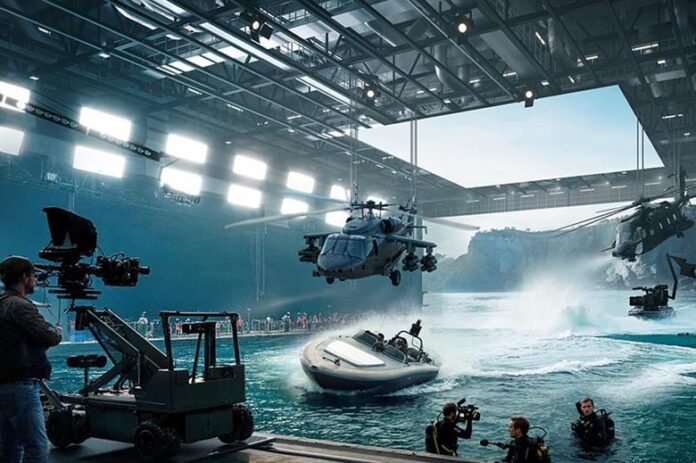
According to details shared by the Malta Film Commission, the “Land-Sea Super Stage” is designed as a hybrid filming environment that bridges traditional studio production with large-scale water-based cinematography.
Environment-Controlled Indoor Water Tank
A central feature of the project is a large, environment-controlled indoor water tank. Unlike Malta’s well-known outdoor “infinity” tanks that utilize the natural Mediterranean horizon, the new facility will allow filmmakers to control lighting conditions, simulated weather, and water effects within a fully enclosed setting.
Controlled environments can offer production teams greater scheduling certainty, reduced weather-related delays, and enhanced safety compliance.
Seamless Land-to-Sea Integration
The facility is designed to enable seamless transitions between land-based set constructions and water-based filming. This approach may reduce logistical complexity for productions that require coastal, maritime, or large-scale aquatic scenes.
By offering both environments within a single integrated production complex, the studio aims to function as a comprehensive filming destination.
Industry observers note that hybrid studio models are increasingly favored in large-scale productions due to their ability to combine creative flexibility with operational efficiency.
Expanding Year-Round Production Capacity
Malta’s Film Commissioner, Johann Grech, stated that the project forms part of a broader strategy to increase year-round production capacity and attract high-budget international projects.
Weather conditions can significantly affect filming schedules in open-air environments. An indoor facility with advanced technical capabilities may allow productions to operate with fewer interruptions and greater budget predictability.
This infrastructure development is also expected to support:
- Increased foreign direct investment in the creative sector
- Local employment in production, construction, and technical services
- Skills development within Malta’s film workforce
- Ancillary economic activity across hospitality and tourism
Malta’s Established Film Infrastructure
Malta Film Studios has long been recognized for its outdoor water tanks, including the Shallow Tank and Deep Tank, which have been used in large-scale maritime productions over the years.
However, until now, the absence of a large indoor super stage has meant that some productions needing complex interior water scenes or controlled environments had to relocate portions of filming to other countries.
The addition of the “Land-Sea Super Stage” could allow entire productions to remain on the island from principal photography through specialized water-based sequences.
Competitive Positioning in the Global Market
The global film production industry is increasingly influenced by infrastructure availability, tax incentives, regulatory stability, and technical capability.
Countries competing to attract international film productions often invest heavily in studio expansions and technological upgrades.
If executed as planned, Malta’s new facility may position the island more competitively alongside established European production hubs.
Regulatory and Development Considerations
Large-scale infrastructure projects typically involve environmental, zoning, and construction approvals under national regulatory frameworks. The Malta Film Commission has not publicly detailed timelines or construction milestones beyond the announcement stage.
Stakeholders and industry participants are expected to monitor official updates regarding project phases, funding mechanisms, and operational timelines.
Conclusion
The unveiling of the “Land-Sea Super Stage” signals Malta’s intent to evolve from a scenic filming destination into a fully integrated, technologically advanced production ecosystem.
By combining indoor environmental control with water-based capabilities, the project reflects broader industry trends toward hybrid production infrastructure.
As global content production continues to expand, infrastructure investments such as this may play a key role in shaping future filming destinations.
Editorial & Compliance Note
This report is based on publicly available announcements and statements attributed to the Malta Film Commission. The article is intended for informational purposes only and does not constitute financial, investment, or development advice. Project timelines, regulatory approvals, and final implementation remain subject to official confirmation by competent authorities.