
Bureau Report | Global Economy & Geopolitics
For decades, India was often viewed as a cautious and protection-sensitive economy in global trade negotiations. However, over the past five years, New Delhi’s trade doctrine has evolved significantly. The signing of the India–EU Free Trade Agreement (FTA) in 2026 — after nearly two decades of intermittent negotiations — symbolizes a decisive shift in India’s global economic engagement strategy.
India’s trade portfolio today reflects strategic flexibility rather than ideological rigidity. The timeline of negotiations now appears to depend less on bureaucracy and more on alignment of interests, trust, and geopolitical timing.
The Spectrum of Negotiation Speed
India’s modern trade agreements fall across a wide negotiation spectrum:
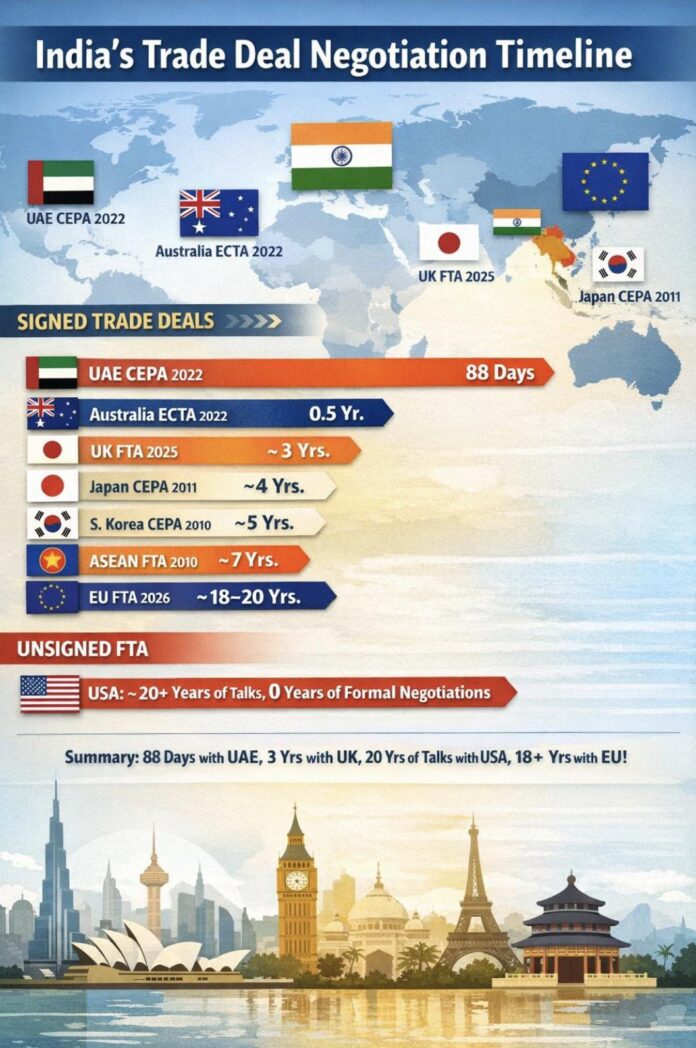
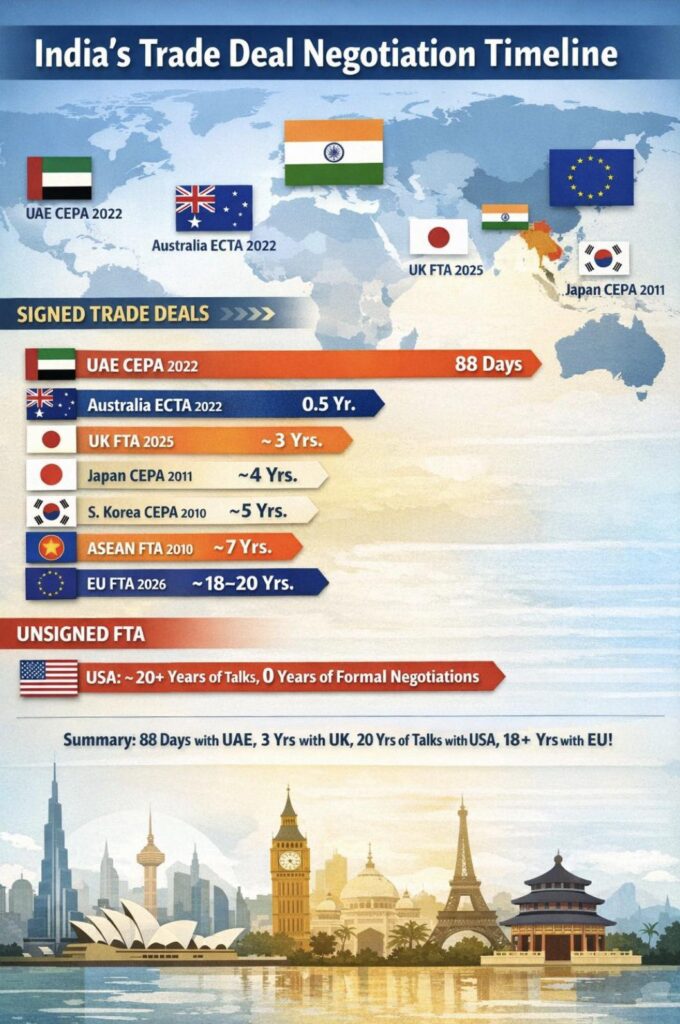
The Sprint – India–UAE CEPA (2022)
Concluded in just 88 days of formal negotiation, the Comprehensive Economic Partnership Agreement (CEPA) with the UAE demonstrated that rapid execution is possible when commercial and strategic interests converge.
The Marathon – India–EU FTA (2026)
Taking approximately 18–20 years, this agreement involved complex negotiations covering sustainability standards, carbon border measures, digital governance, services mobility, and regulatory harmonization.
The Middle Path – UK FTA (2025) & Australia ECTA (2022)
These agreements adopted a phased approach, focusing on services, mobility, and select tariff reductions while postponing sensitive agricultural discussions.
The Strategic Pivot
The defining feature of India’s current trade strategy is adaptability. Rather than pursuing speed alone, India appears to evaluate:
• Market size
• Strategic leverage
• Sectoral sensitivity
• Long-term geopolitical positioning
In a world marked by supply chain realignments and regional trade blocs, India is positioning itself as a stable, rule-based manufacturing and services partner.
Beyond Tariffs
Modern FTAs are no longer limited to tariff cuts. They now include:
• Digital trade governance
• Data protection standards
• Labor and environmental commitments
• Intellectual property safeguards
• Dispute settlement frameworks
India’s participation in such frameworks indicates growing confidence in domestic regulatory capabilities.
One-Line Strategic Summary
India has demonstrated it can finalize a deal in 88 days (UAE), negotiate over 20 years (EU), or sustain strategic engagement without signing a formal FTA (US) — reflecting a calibrated, interest-driven diplomacy model.
Editorial Note:
This article is based on publicly available trade timelines and policy announcements. ReportingNewsWorld maintains editorial neutrality and encourages readers to consult official government notifications for complete legal texts.