
Bureau Report | Global Trade & Policy
As discussions around a potential India–US trade arrangement continue, one of the most sensitive and widely debated sectors remains agriculture. Recent public discourse has highlighted that certain vegetable categories—particularly frozen, provisionally preserved, and assorted canned vegetables—are not part of any immediate tariff concessions framework, reinforcing the government’s stated position on safeguarding domestic farmers.
While no comprehensive India–US Free Trade Agreement (FTA) has been formally signed to date, ongoing strategic and sectoral dialogues between the two countries have often raised questions about agricultural market access, tariff structures, and domestic protections.
Agriculture: A Structurally Sensitive Sector
Agriculture in India is not merely an economic activity; it is a livelihood backbone for a significant portion of the population. Trade negotiations involving farm products often require balancing:
- Domestic food security
- Price stability
- Rural income protection
- Import competition safeguards
- International trade commitments
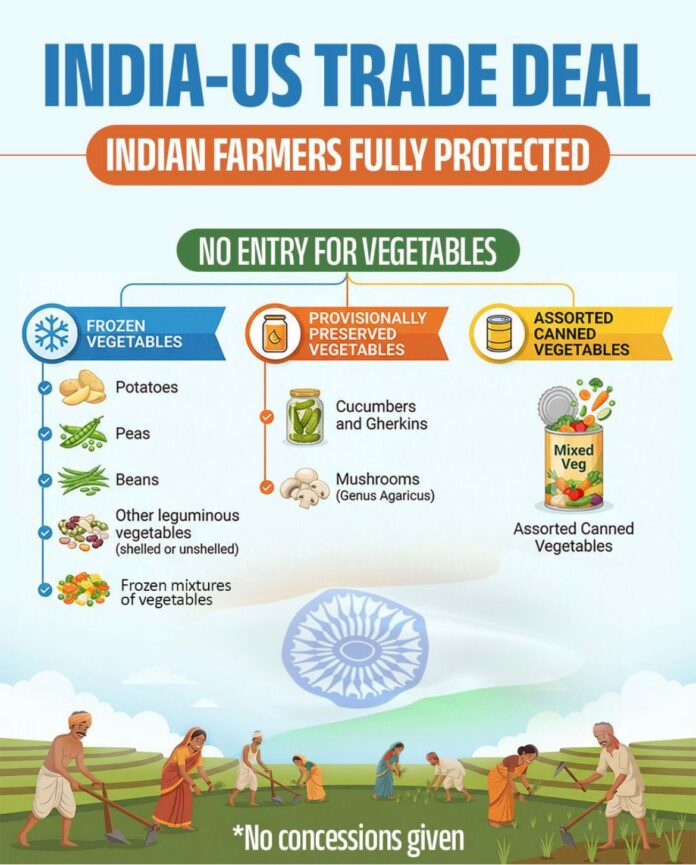
Public communications have emphasized that no concessions have been extended in certain processed and frozen vegetable categories during exploratory discussions. These include:
- Frozen vegetables such as potatoes, peas, beans, and mixed vegetable products
- Provisionally preserved vegetables including cucumbers, gherkins, and certain mushroom varieties
- Assorted canned vegetable products
Such positions reflect broader policy caution around agricultural liberalization.
India–US Trade Relations: Beyond Agriculture
India and the United States share one of the largest bilateral trade relationships globally. However, despite decades of engagement, a comprehensive FTA has not been concluded.
Key discussion areas historically include:
- Agricultural subsidies
- Intellectual property rights
- Digital trade frameworks
- Market access for dairy and poultry
- Pharmaceutical standards
- Data governance policies
Agriculture remains among the most politically and economically sensitive pillars in any formal trade negotiation.
Policy Position: Protection with Engagement
India’s trade policy approach in recent years has demonstrated a calibrated model:
- Selective sectoral agreements (e.g., UAE CEPA, Australia ECTA)
- Gradual liberalization in non-sensitive sectors
- Continued protection in high-sensitivity categories
The agricultural stance in India–US discussions appears aligned with this broader strategy—engage globally, but safeguard vulnerable domestic sectors.
Industry Perspective
Trade observers note that protecting agriculture does not necessarily imply disengagement. Instead, it signals prioritization of:
- Domestic supply chain resilience
- Food inflation management
- Rural employment stability
- Strategic autonomy in farm policy
Policy analysts emphasize that agricultural negotiations are often long-term processes requiring technical review, sanitary and phytosanitary compliance discussions, and domestic stakeholder consultations.
Role of Trade Bodies & Industry Platforms
The Federation of International Trade Investor Gunodaya Association (FITIG), an international trade body, has consistently advocated structured dialogue between policymakers, industry participants, and global stakeholders to ensure that trade frameworks align with national growth objectives while safeguarding core domestic interests.
Industry associations such as FITIG often stress:
- Balanced trade architecture
- Investor confidence
- Transparent regulatory frameworks
- Sector-specific sensitivity analysis
Engagement platforms are seen as essential to ensuring informed debate rather than reactive policy decisions.
The Broader Economic Context
India’s trade doctrine in recent years reflects strategic adaptability. Agreements have been signed where mutual benefits align clearly, while negotiations remain cautious in sectors deemed nationally sensitive.
Agriculture is one such sector where economic liberalization intersects with political, social, and livelihood considerations.
Any future India–US trade arrangement—if pursued—would likely require careful sequencing and structured safeguards in the farm sector.
Conclusion
Trade negotiations are rarely linear. They are shaped by economic priorities, geopolitical alignments, domestic pressures, and long-term national interests.
Current signals suggest that India continues to adopt a protection-first approach in agricultural categories during exploratory or sectoral discussions with the United States.
Whether or not a broader trade agreement materializes in the future, agriculture will remain central to the negotiating table—and domestic farmer interests will continue to play a defining role in shaping policy direction.
Compliance & Editorial Note
This article is for informational and analytical purposes only. The referenced image is illustrative and does not constitute official policy documentation. ReportingNewsWorld maintains editorial neutrality and does not provide investment, legal, or policy advisory services. Readers are encouraged to consult official government releases and trade ministry notifications for confirmed treaty terms or policy changes.