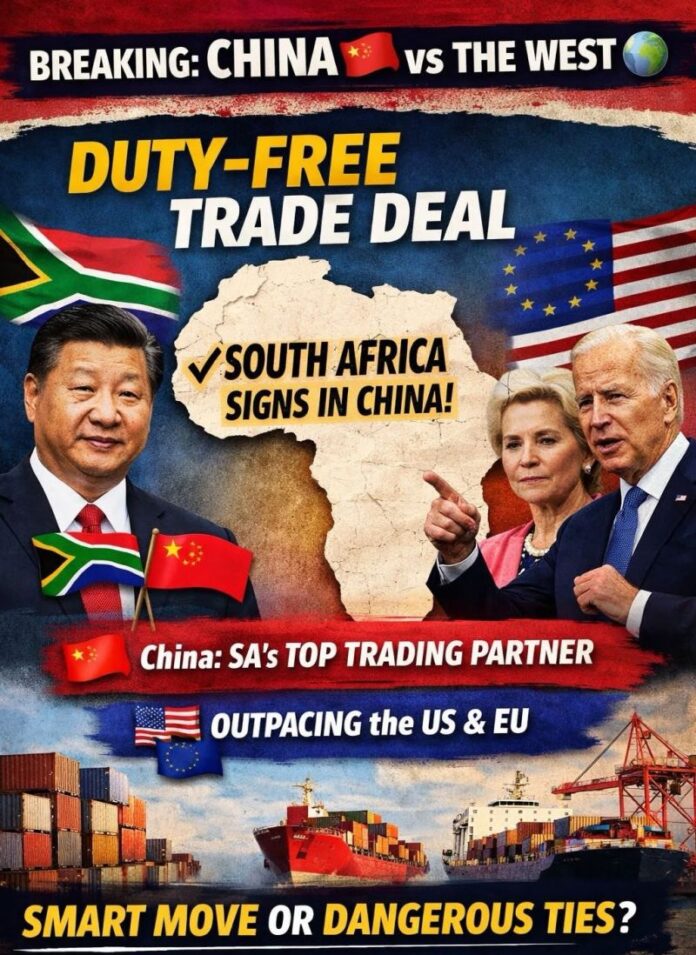

Bureau Report | Global Trade & Geopolitics
China and South Africa are reportedly finalizing a duty-free trade arrangement covering selected products, marking a potential shift in Pretoria’s external trade alignment. While official documentation outlining the full scope of the agreement is awaited, public statements indicate that South Africa’s Trade Minister is expected to formalize the understanding during engagements in China.
The proposed framework aims to expand South African exports to China while encouraging greater Chinese investment inflows.
Context: A Changing Trade Landscape
South Africa’s global trade relationships have evolved significantly over the past decade. According to publicly available trade statistics, China emerged as South Africa’s largest trading partner in 2023, overtaking the European Union in total trade value.
Trade between the two countries has largely centered around:
- Mineral exports (including iron ore, manganese, and platinum group metals)
- Agricultural products
- Manufactured goods
- Machinery and electronics imports
The new duty-free framework—if implemented as outlined—could deepen this economic integration.
Market Diversification Amid Diplomatic Strain
The development comes amid reported strains in South Africa’s relations with certain Western partners. While trade diplomacy is often dynamic and multi-layered, diversification strategies are not uncommon for emerging economies seeking broader market access.
From a policy perspective, diversification can offer:
- Reduced reliance on a single trade bloc
- Expanded export channels
- Investment pipeline development
- Greater negotiating leverage in global trade discussions
However, deeper integration with any major power also raises structural considerations.
Potential Economic Benefits
Supporters of expanded China–South Africa trade engagement argue that the move could:
- Enhance export competitiveness through tariff reductions
- Improve access to Chinese consumer markets
- Attract infrastructure and industrial investment
- Support job creation in export-oriented sectors
China remains one of the world’s largest commodity importers, and South Africa’s resource base positions it strategically within global supply chains.
Structural Risks & Policy Debate
Critics and analysts caution that heavy trade concentration with a single major partner may introduce long-term vulnerabilities.
Common concerns raised in economic discourse include:
- Commodity dependency
- Trade imbalance risks
- Limited value-add industrialization
- Potential overexposure to geopolitical shifts
Such debates are not unique to South Africa; similar discussions have emerged across multiple African economies engaged in large-scale trade partnerships.
The Broader African Perspective
Across the continent, governments are navigating a complex trade environment shaped by:
- The African Continental Free Trade Area (AfCFTA)
- Strategic engagement with China
- Continued economic ties with the US and EU
- Expanding South–South cooperation
For many African policymakers, the central question is not binary alignment but balanced engagement.
Strategic Autonomy vs. Dependency
Whether deeper trade integration with China constitutes a strategic economic opportunity or a dependency risk depends on several variables:
- Product diversification
- Industrial policy alignment
- Domestic value-add capacity
- Debt sustainability
- Export diversification strategy
Economic experts often emphasize that trade agreements must be evaluated not only on tariff reductions but also on long-term structural impact.
Conclusion
The potential China–South Africa duty-free trade framework reflects the evolving global trade order. As emerging economies recalibrate relationships, strategic diversification is increasingly common.
For South Africa—and for African economies more broadly—the debate centers on balancing opportunity with resilience.
Is deeper trade integration with China a pathway to accelerated growth?
Or does it risk creating long-term structural concentration?
The answer may ultimately depend on how trade diversification is managed—not merely who the partner is.
Compliance & Editorial Note
This article is for informational and analytical purposes only. The referenced image is illustrative and does not represent official treaty documentation. Readers are encouraged to consult official government releases and verified trade statistics for confirmed details. ReportingNewsWorld maintains editorial neutrality and does not provide investment, diplomatic, or policy advisory services.