
Bureau Report | Critical Minerals & Energy | New Delhi, Bharat (India)
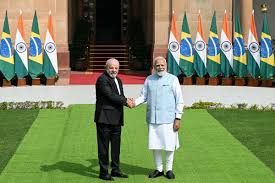
In a move set to redefine the geopolitics of the green energy transition, Prime Minister Narendra Modi and Brazilian President Luiz Inácio Lula da Silva signed a landmark cooperation agreement in New Delhi on Saturday, February 21, 2026. The pact specifically targets the exploration, processing, and refining of rare earth elements (REEs) and critical minerals, positioning the two nations as a formidable alternative to traditional supply chain monopolies.
The timing of the deal is critical. As global industries scramble to secure the materials necessary for electric vehicles (EVs), semiconductors, and defense systems, the “Modi-Lula” pact signals a shift toward Global South autonomy. Brazil currently holds the world’s second-largest reserves of rare earth minerals, while India possesses one of the world’s fastest-growing industrial appetites for these resources.
Breaking the “Processing Bottleneck”
While Brazil is mineral-rich, it has historically exported raw ores rather than refined products. The new agreement seeks to change this dynamic by integrating Indian technical expertise in mineral separation with Brazilian resource wealth.
- Technology Exchange: India’s National Critical Minerals Mission will share advanced refining and permanent magnet manufacturing techniques with Brazilian state-backed mining entities.
- Infrastructure Support: Joint ventures are expected to be established in the Brazilian states of Minas Gerais and Goiás to build on-site processing plants, reducing the carbon footprint of trans-continental shipping.
- Targeted Minerals: Beyond traditional rare earths like Neodymium and Praseodymium, the deal focuses on Niobium (of which Brazil is the world’s top producer) and Lithium.
Geopolitical Context: Decoupling and De-risking
The agreement comes amidst heightened global trade tensions. Following the “tariff wars” of 2025 that impacted both nations, New Delhi and Brasília have pivoted toward “de-risking” their economies from external shocks.
“This is not just a trade agreement; it is a resilience pact,” stated a senior official from India’s Ministry of Mines. “By building a vertical supply chain within the Global South, we ensure that our EV and high-tech sectors are protected from the price volatility and export quotas seen in Northern markets over the last 24 months.”
Bilateral Trade Targets: The $20 Billion Goal
The rare earth deal is the centerpiece of a broader economic roadmap. Bilateral trade between India and Brazil crossed $15 billion in 2025, and both leaders have now officially committed to reaching $20 billion by 2030.
| Sector Impact | Expected Growth Factor | Key Objective |
| Electric Vehicles | 4.5x by 2028 | Securing high-grade magnets for domestic motors. |
| Aerospace (Embraer-Adani) | 3.0x by 2030 | Use of Niobium-steels for high-temp engine parts. |
| Renewable Energy | 2.5x by 2027 | Lowering costs for wind turbine generator components. |
The “Smart Investor” View
Market analysts suggest that this deal creates a new “Critical Mineral Corridor.” For investors, the focus is now on Brazilian junior mining firms and Indian manufacturing giants that stand to benefit from preferential trade status under the India-MERCOSUR expanded agreement, which was also discussed during the summit.
Editorial & Compliance Note This article reflects market commentary and publicly discussed information. It is intended for informational purposes only and does not constitute investment advice, financial recommendation. ReportingNewsWorld maintains editorial neutrality and does not provide economic advisory services.