
From 1986 to 2025: What the Evolution of India’s Benchmark Index Reveals About Markets, Disruption and Survival
Bureau Report | Markets & Economy
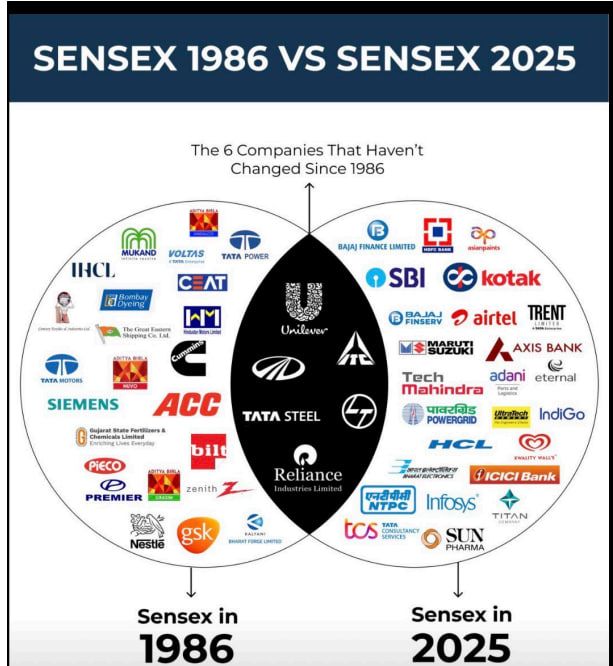
In 1986, the BSE Sensex reflected the industrial backbone of India’s economy. Manufacturing conglomerates, utilities, cement companies, and legacy industrial houses dominated the index. The composition mirrored the structure of a largely protected and production-driven economy.
Fast-forward to 2025, and the transformation is unmistakable.
Banks, financial services firms, technology companies, telecom operators, aviation players, and digital-era enterprises now represent a significant portion of India’s benchmark index. The shift tells a deeper story—not just about stock markets, but about economic transition, structural reform, and business adaptability.
Yet amid this sweeping change, only a handful of companies have survived across the entire journey.
That, perhaps, is the real lesson.
The Evolution of India’s Economic DNA
Stock indices are not static monuments. They are living representations of economic power structures at any given time.
In 1986, India’s corporate ecosystem was shaped by:
- Capital-intensive manufacturing
- Infrastructure and utilities
- State-influenced industrial giants
- Domestic-focused conglomerates
By 2025, the picture reflects:
- Financial sector deepening
- Technology-led growth
- Capital markets expansion
- Telecom and digital transformation
- Global supply chain integration
This transition aligns with India’s broader macroeconomic evolution—from a controlled industrial economy to a liberalized, service-driven, globally integrated system.
The Six Survivors
Across nearly four decades, only six companies reportedly remained part of the index composition throughout the full period.
Their survival highlights a principle often overlooked in market commentary:
Longevity is rarely accidental.
These companies navigated:
- Economic liberalization (1991 reforms)
- Global financial crises
- Regulatory overhauls
- Technological disruption
- Competitive industry cycles
Survival required reinvention—not mere stability.
Indices Evolve. Businesses Must Too.
Index reshuffling is not a failure—it is a feature of capital markets.
Companies enter and exit based on:
- Market capitalization
- Liquidity criteria
- Sectoral relevance
- Business performance
As industries mature or decline, representation shifts. Manufacturing-heavy indices give way to financial services. Telecom expands. Technology rises. Aviation enters. Energy transitions reshape valuations.
The Sensex of 2025 reflects India’s growth in digital payments, private banking penetration, IT exports, and consumer-driven sectors.
What disappears quietly are businesses that could not scale, modernize, or compete in new economic realities.
The Real Investment Insight
The broader takeaway is not about nostalgia for 1986 or excitement for 2025.
It is about adaptability.
Long-term wealth creation in equities historically aligns more closely with:
- Governance discipline
- Capital allocation efficiency
- Innovation capacity
- Market relevance
- Strategic agility
Sector prediction alone rarely guarantees longevity. Markets reward evolution.
As economic cycles rotate, capital shifts accordingly. Businesses that recognize structural change early tend to endure. Those that rely solely on legacy advantage often fade.
Disruption Is Not a Phase — It’s the Baseline
Across decades, the one constant in markets has been change.
Liberalization disrupted monopolies.
Globalization reshaped competitiveness.
Technology altered consumer behavior.
Digital finance transformed banking models.
Indices adjust to reflect this reality.
The idea of permanence in markets is often overstated. Corporate leadership can shift within a decade. Entire industries can shrink or expand rapidly.
In that context, survival itself becomes a form of outperformance.
A Broader Economic Reflection
The Sensex comparison between 1986 and 2025 is not merely about companies—it is about India’s economic maturation.
- From production-led to services-led growth
- From closed economy to export-driven participation
- From public-sector dominance to diversified private enterprise
- From analog to digital
Markets act as mirrors of that transformation.
Closing Perspective
“Sensex changes. Survivors don’t.”
Indices evolve. Economies upgrade. Disruption is continuous—not episodic.
For long-term participants in capital markets, the lesson may not lie in forecasting the next dominant sector. Instead, it may rest in identifying businesses capable of adapting while others quietly exit the stage.
In markets, permanence is rare.
Adaptation is everything.
Compliance & Editorial Note
This article is for informational and educational purposes only. The referenced image is used illustratively to depict index composition comparison and does not constitute investment advice. Readers should consult qualified financial advisors before making investment decisions. ReportingNewsWorld maintains editorial neutrality and does not endorse specific securities.